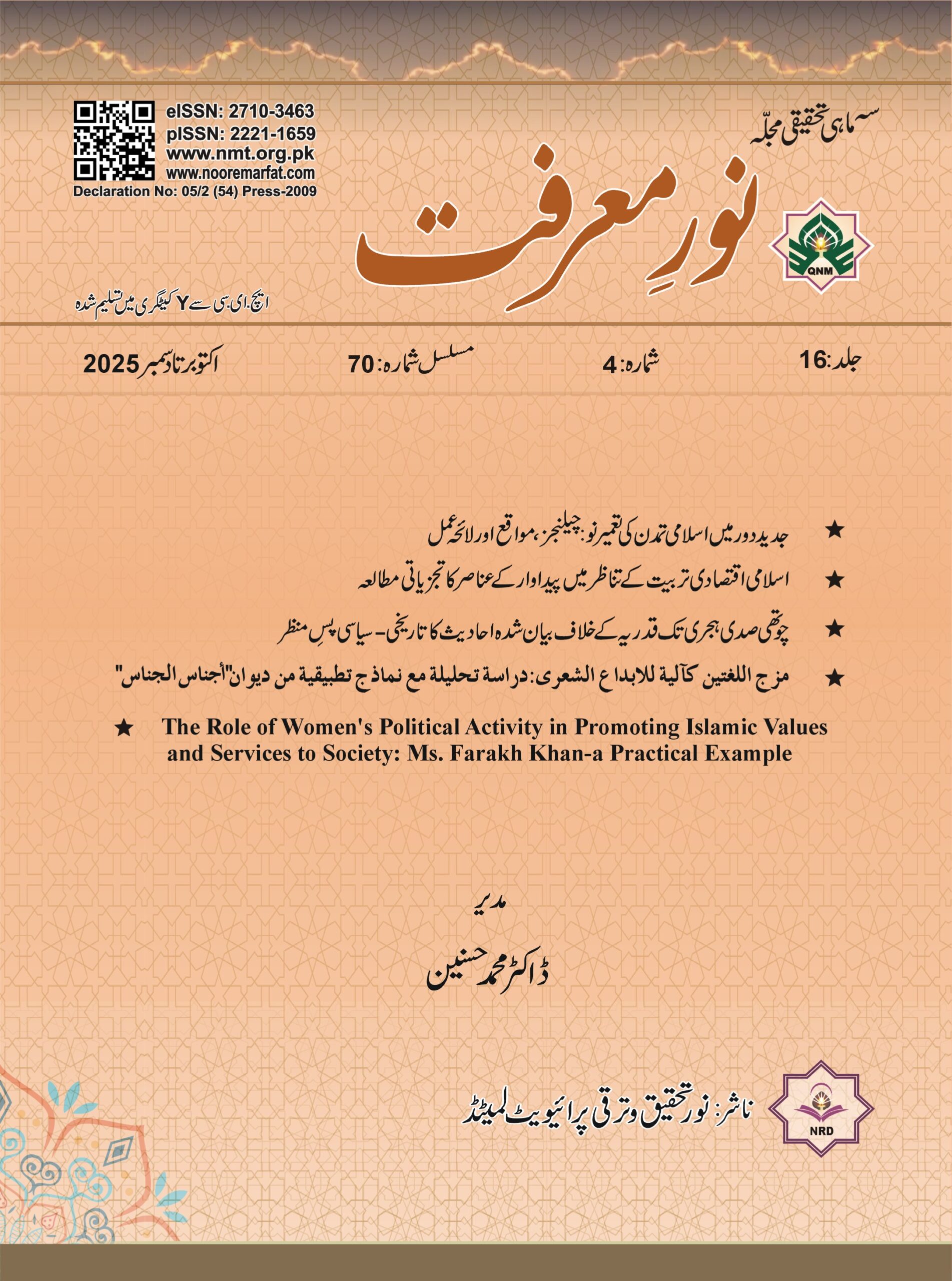
Noor-e-Marfat Issue 70
رکنیت حاصل کرنے کے لیے یہاں کلک کریں۔
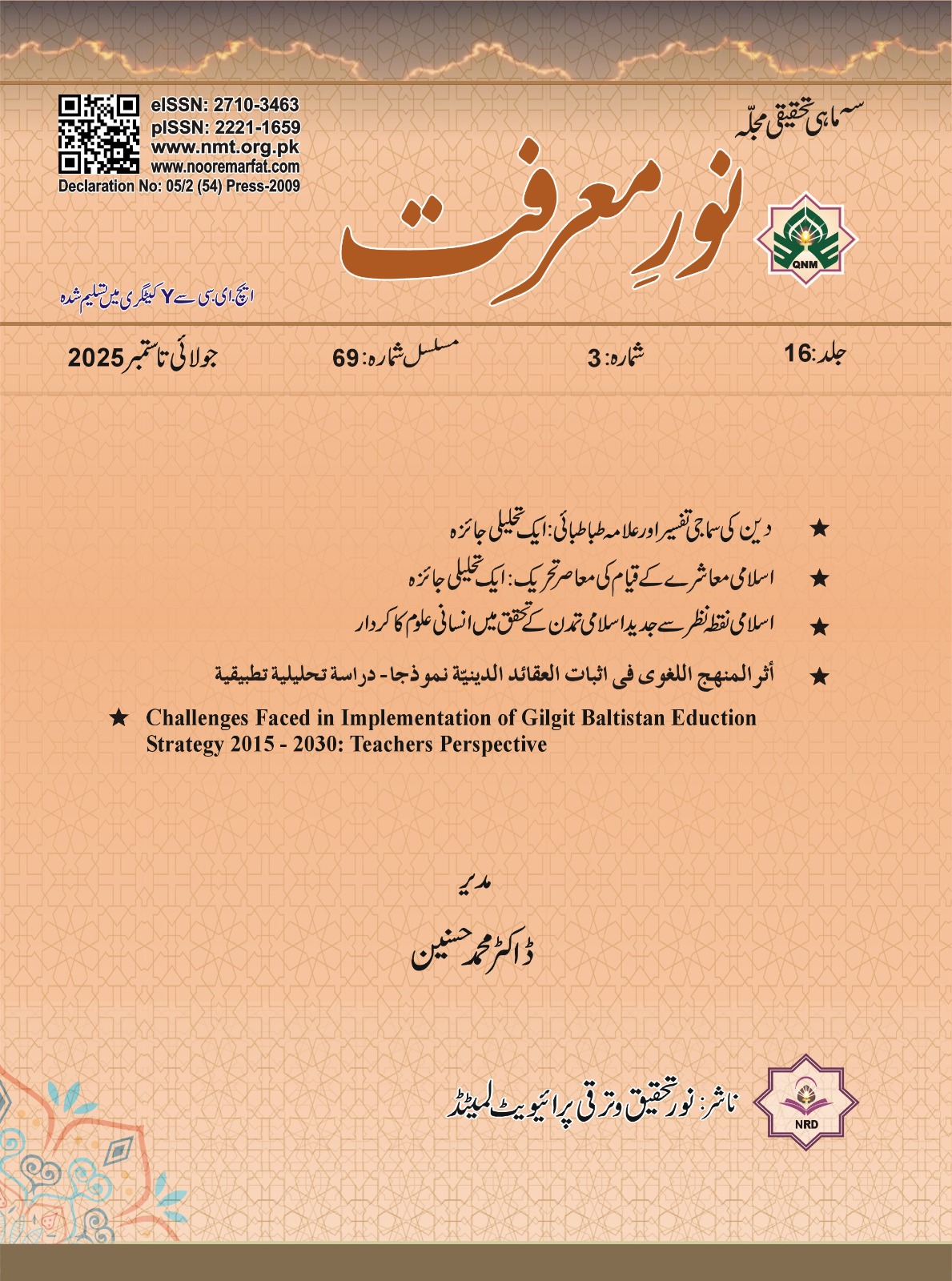
The 69th issue of the quarterly research journal “Noor-e Ma’rfat” consists of five research articles, with given below core content:
The 1st article discusses the motivations of the contemporary movement for the establishment of an Islamic society, some excellent examples of this movement, and its positive and negative dimensions. This article also examins some important challenges that this movement may face.
The 2nd article attempts to clarify the way to strengthen the Islamic foundations of human sciences. According to this article, human sciences determine the direction of movement of individuals and societies. So, establishing these sciences on the Islamic concept of the universe is a campaign that will pave the way for the establishment of an Islamic civilization.
The 3rd article critically examines the ideas and thoughts of sociologists who consider religion to be a social phenomenon. Rejecting this viewpoint, the article contains an explanation of the ideas of Allama Syed Muhammad Hussain Tabatabai, according to whom the man’s nature is built upon religion; and social environment is just a necessary condition for the manifestations of religion.
The 4th article in this issue examines how the rules of language and expression, especially the rules of Arabic grammar and eloquence, are effective and involved in the affirmation and explanation of religious and Islamic beliefs from the basic textual sources. This article claims that the Shia Imamiyyah took special care to ensure that the general rules of Arabic grammar were fully adhered to in the expression and affirmation of religious beliefs. That is why Shia Imamiyyah were protected from personification of Allah almighty, his analogy, and quiddity etc.
The 5th article in this issue examines the challenges and difficulties faced in the implementation of the “Educational Strategy-2015-2030” for the promotion of education in Gilgit-Baltistan. This article explores the subject from the perspective of GB teachers and presents very useful and practical suggestions for overcoming the difficulties faced in the implementation of this strategy
Full Issue

رکنیت حاصل کرنے کے لیے یہاں کلک کریں۔
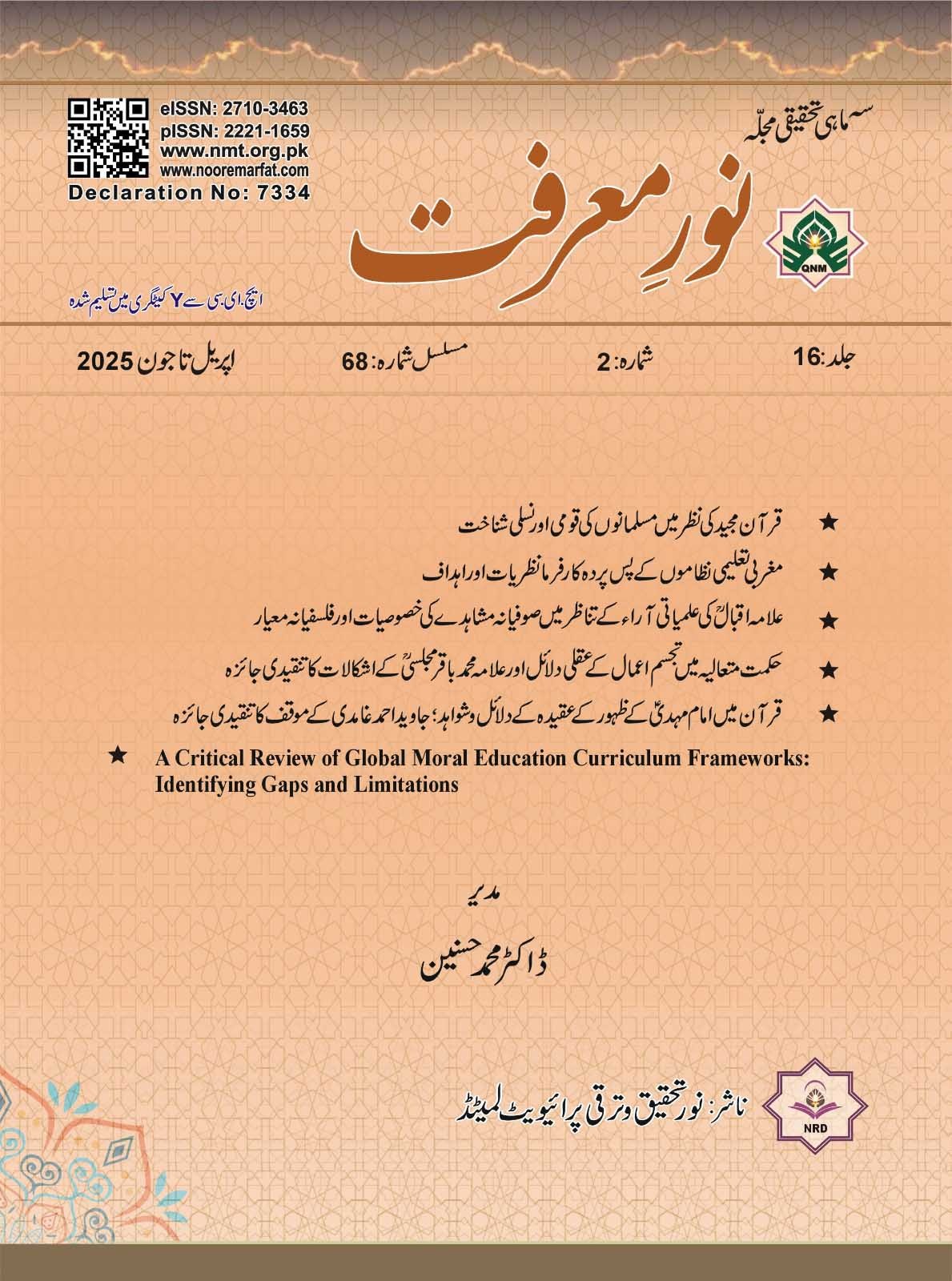
This Issue contains 6 research articles. The first article examines the factors that shape the national identity of Muslims from the perspective of the Quran. The 2nd article examines two general issues. One, on what intellectual, philosophical and religious ideas are the educational systems prevalent in the present world based? Second, if we want to base any system of education and training on the teachings of Islam, what is its starting point? The 3rd article sheds light on the rational arguments for the embodiment of our deeds on the Day of Judgment from the perspective of Mulla Sadra’s philosophy. In the 4th article, mystical experiences and Sufi observations are presented as an important factor in the formation of Islamic civilization in the context of Allama Iqbal‘s sermons. The philosophical validity and scientific value of these experiences and observations are highlighted here. In the 5th article, while rejecting the view of the renowned religious scholar Mr. Ghamidi regarding the belief in the appearance of Imam Mahdi (AS), he presents 5 verses of the Holy Quran in support of the correctness and validity of this belief. The last article draws on research from national education systems in selected countries, including UNESCO, OECD, the United Kingdom, Japan, Malaysia, Pakistan, and Norway, to identify key gaps and challenges, which are attributed to excessive politicization, cultural non-universality, superficial treatment of moral values, and insufficient stakeholder involvement. The paper, while acknowledging the strengths of existing models of moral education, emphasizes the need for a more comprehensive and philosophically grounded approach to moral education.
Full Issue
رکنیت حاصل کرنے کے لیے یہاں کلک کریں۔
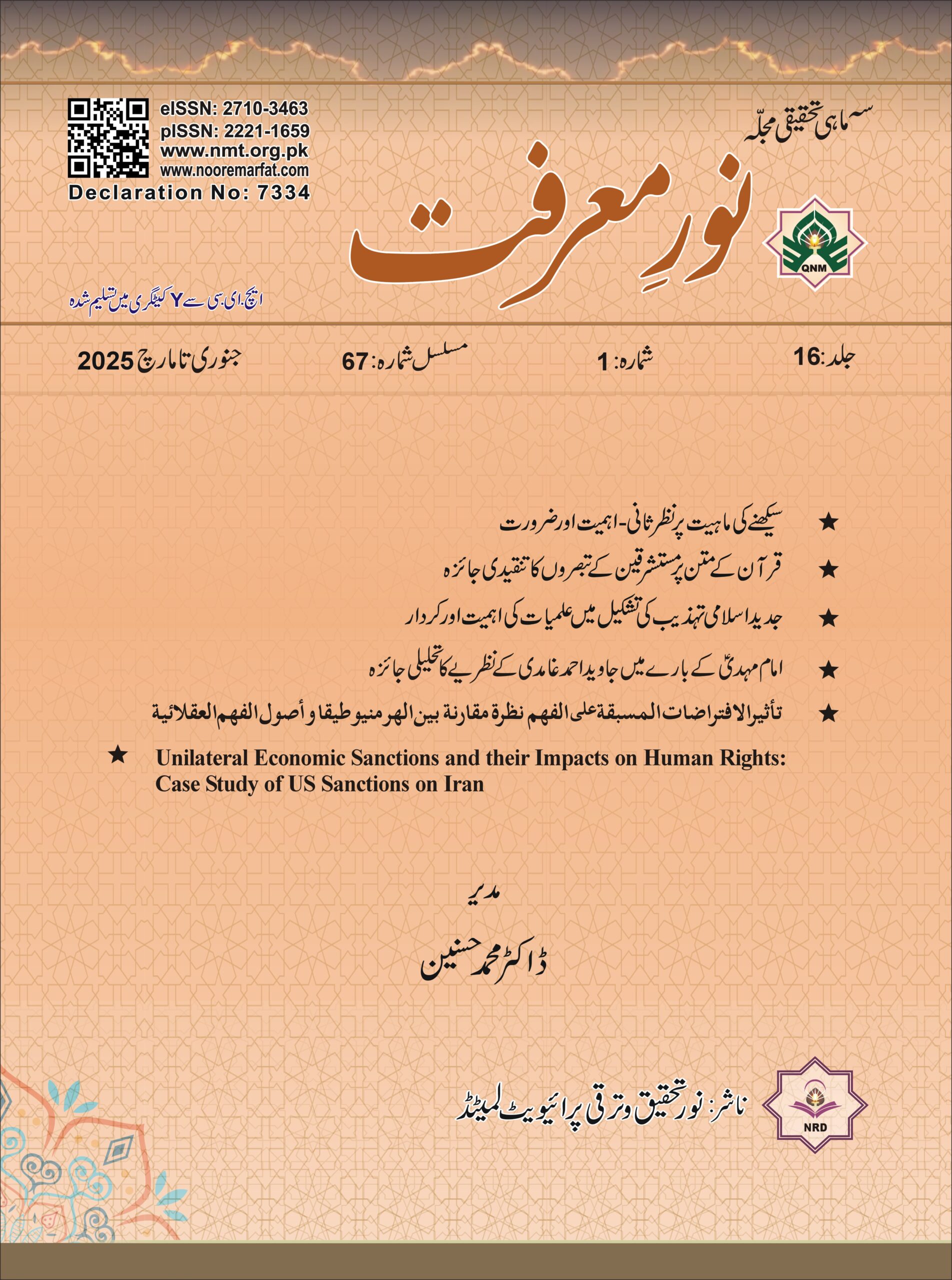
The 67th issue of the quarterly research journal “Noor-e-Ma’rfat” contains 6 scholarly articles. The 1st article defends the common belief of all Muslims that the Holy Quran is a revealed book whose text is not the words of any human being, but the word of Allah Almighty. The 2nd article carries a key message that contemporary taxonomies –especially Bloom- that describe the goals and outcomes of learning, suffer serious problems and need to be reconsidered. 3rd article answers this question how it is possible to shape Modern Islamic civilization from the viewpoint of Allama Muhammad Iqbal. 4th article analysis Mr. Javed Ahmad Ghamidi;s refuse of the belief in the appearance of Imam Mahdi (A.S.). 5th article examines Hans-Georg Gadamer’s theory of understanding a text and declares it as incompatible with the methodology of comprehension that the desicpline of Usul-e Fiqh puts forward; i.e, “generic appearance” (zuhūr naw‘ī). At the end, 6th article examines the reasons why Iran is under US sanctions. The article focuses on the success and failure of US sanctions on Iran, as well as the impact of these sanctions on the Iranian people.
Full Issue
رکنیت حاصل کرنے کے لیے یہاں کلک کریں۔
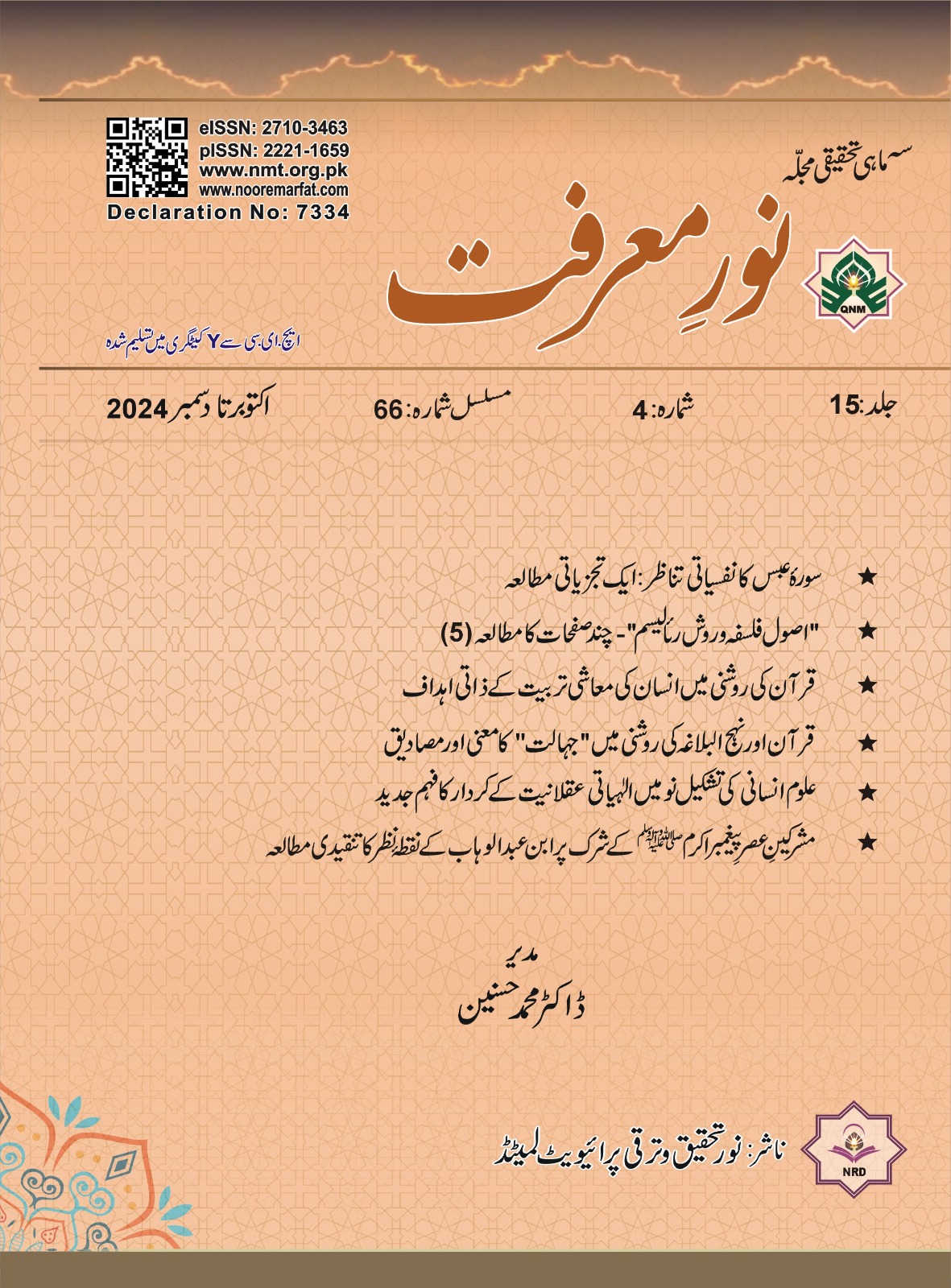
This issue contains 6 scholarly articles. 1st article defines personal goals of economical upbringing of human beings in the light of Holy Quran. 2nd article discusses the meanings and displays of “Ignorance” in the light of Holy Quran and Najh-ul- Balagah. 3rd article demonstrates psychological impacts of words and phrases of Holy Quran in Sura-e Abus. 4th article is a commentary about a few pages from a philosophical work: “Usul-e Falsaf wa Rawish-e Realism” by Allama Tabatabaie. 5th article define the impact of Islamic philosophical rationality in the reconstruction of social sciences and the final article is a critical evaluation of Muhammad Ibn-e Wahhab’s views about Monotheism and Polytheism.
Full Issue
رکنیت حاصل کرنے کے لیے یہاں کلک کریں۔
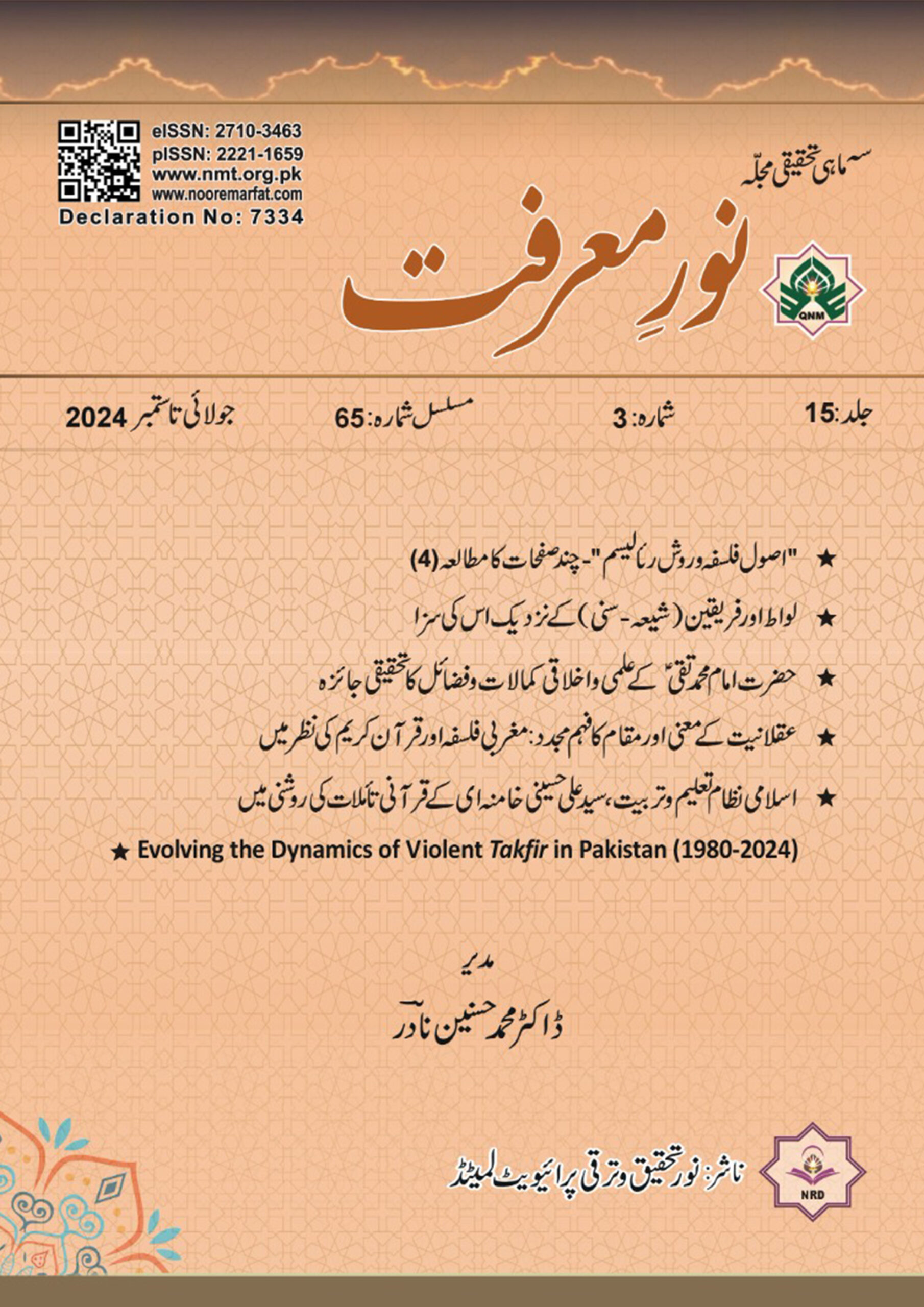
This issue of quarterly research journal “Noor-e- Marfat” contains 5 papers. The 1st paper discusses divine goals of human economic upbringing in the light of the Holy Qur’an and the traditions of infallibles (A.S). The 2nd paper presents a review of different periods and history of Imamiyah political jurisprudence. The 3rd paper examines the status of efforts for the establishment of Islamic government in the period of great occultation. The 4th paper narrates the definition of philosophy, the types of cognition, the necessity of philosophy and its difference from other sciences in the light of Allama Tabatabai and Murtaza Muthari’s works. And the last paper examines the role of philosophy and mathematics in the creation of social realities; in the context of theory of ‘Divine Economics’.
Full issue
رکنیت حاصل کرنے کے لیے یہاں کلک کریں۔
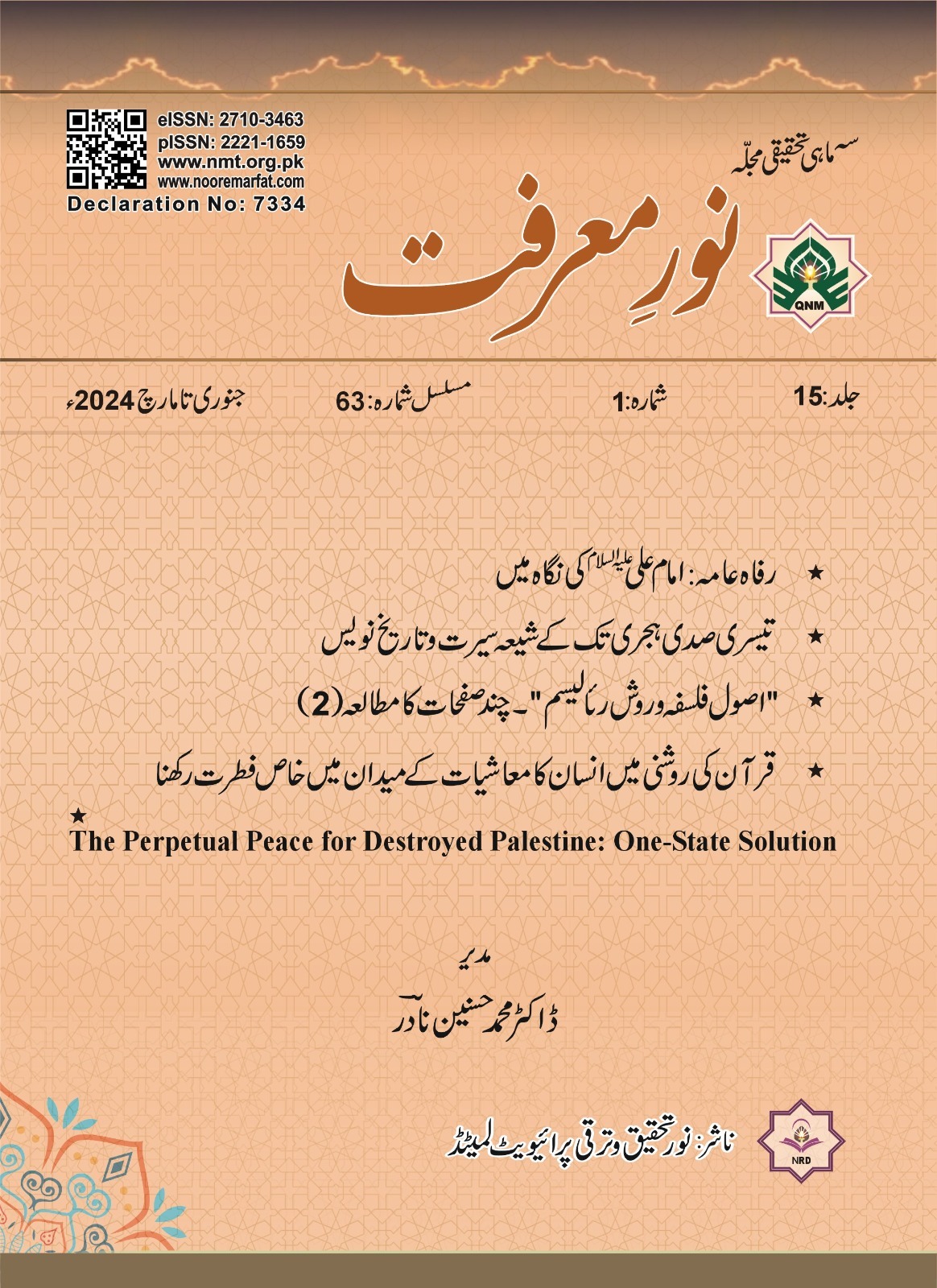
This issue of quarterly research journal “Noor-e- Marfat”, contains 5 articles. The 1st paper discusses Man’s special nature regarding Economics. According to this article man’s awareness of his economical nature can lead him to promote a welfare Islamic society to come into existence. The 2nd article presents an excellent argument regarding why metaphysical debates are central to philosophical debates in the light of Allama Tabatabai’ book “Usul-e Falsafah wa Rowish-e Realism”. This paper also includes a strong criticism of the dialectical materialism of Karl Marx and Engels. The 3rd paper introduces the Shia biographers and historians of the third century Hijri in the light of the book “Political History of Islam” by a well-known researcher, Professor Rasul Jafarian. The next paper discusses the efforts made during the reign of Hazrat Ali (A.S.) to create a welfare state and a prosperous society. And the 5th paper examines the root cause of the Palestine problem, according to which the two-state solution of this problem is involved in many legal difficulties. So, the real solution to this problem lies in the formation of a unified state; a state in which all Palestinians are equal citizens and partakers, regardless of their religion, race or color.
Full Issue
رکنیت حاصل کرنے کے لیے یہاں کلک کریں۔
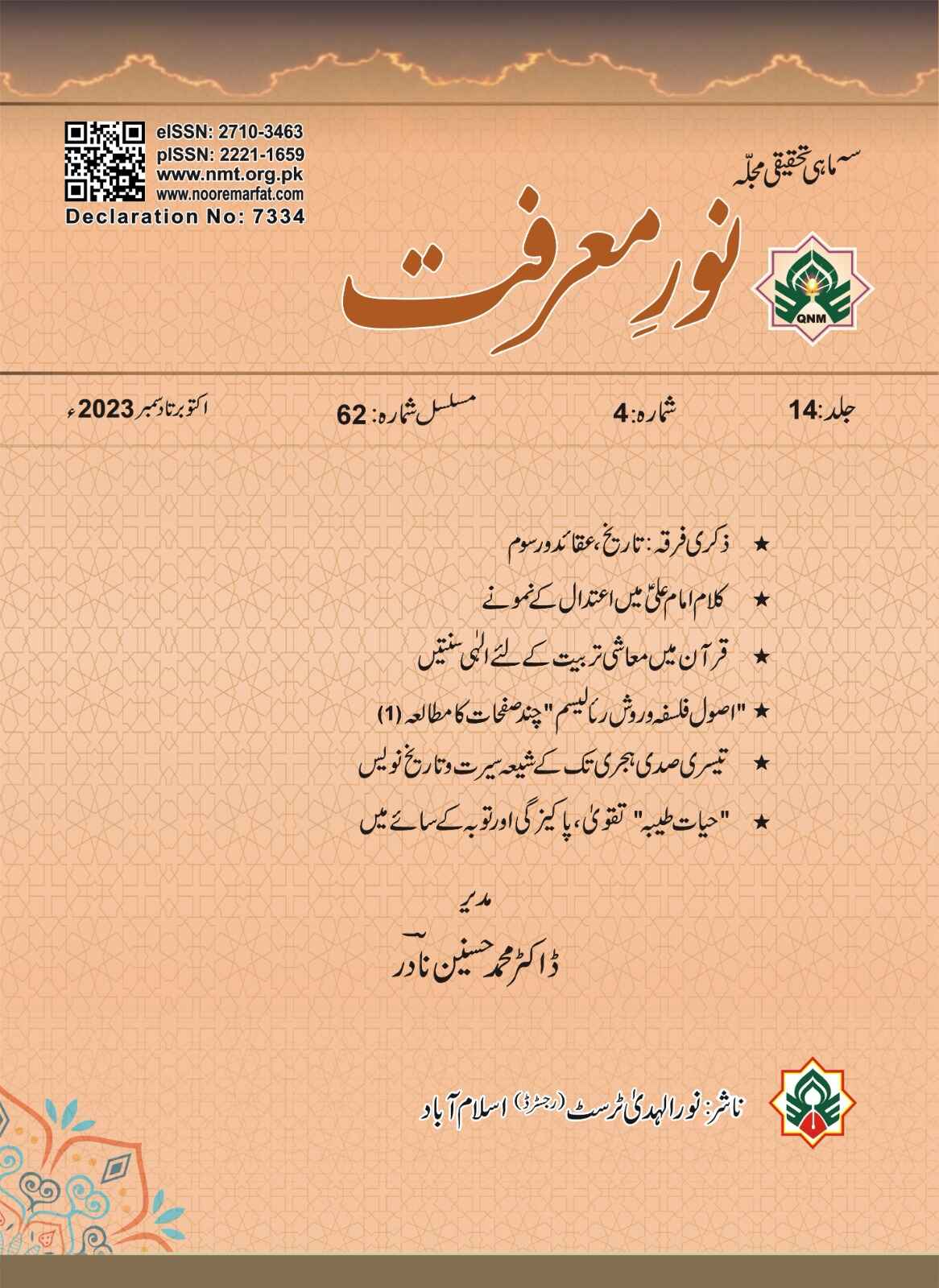
This issue of quarterly research journal “Noor-e- Marfat”, contains 6 scholarly articles. The first two articles guide us how we can bring the prosperity and welfare to our lives. The 3rd article also highlights the role of some practices like piety, trust, gratitude, charity, lending, and marriage in increasing our sustenance and wealth. The 4th paper sheds light on the works of Shia historians. It introduces 20 books compiled by the Shiites on the history and biography of the Prophets, particularly the holy Prophet (PBUH). The 5th paper throws a light upon the ‘importance of knowledge and its sanctity’, ‘the reliability of knowledge and its scope for being errorless’ from the viewpoint of Allama Tabatabai‘s book “Usul-e Filsafah wa Rawish-e Realism“. Finally, the 6th article presents an introduction to the “Zhikri” sect, found in Pakistan’s Baluchistan and Sindh provinces, as well as Iranian Baluchistan.
Full Issue
رکنیت حاصل کرنے کے لیے یہاں کلک کریں۔
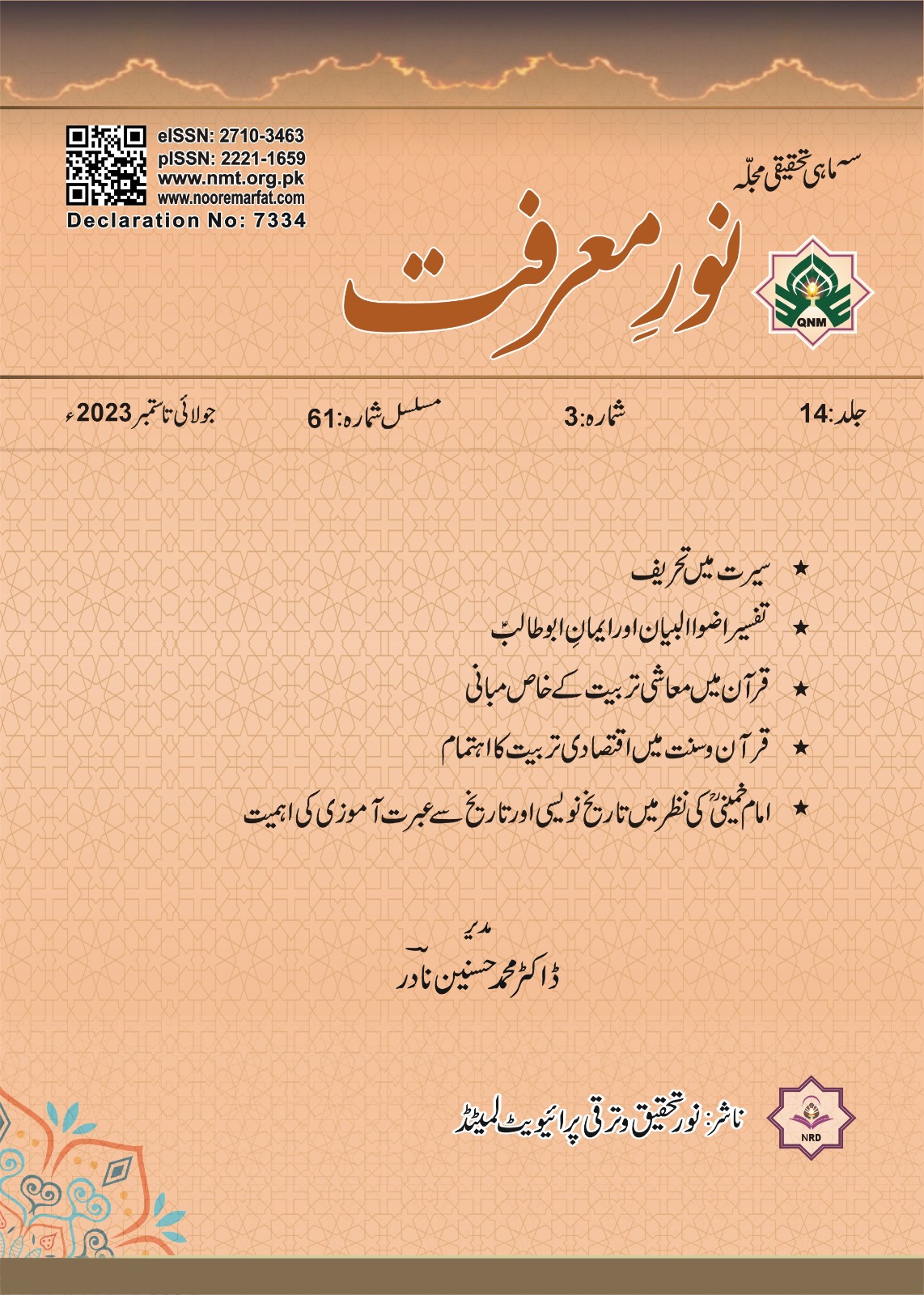
The 61st issue of quarterly research journal “Noor-e- Marfat” contains 6 articles. The first two articles of this issue guide academicians to devise a system of economic education and training based on these foundations that will guide governments, experts, and every member of the society to adjust their economic life accordingly. The title of the 3rd article evaluates Shanqiti’s denial of the faith in Hazrat Abu Talib’ in his Tafsir “Azwa al-Bayan”, under verse 91 of Surah-e Hud. The writer of this paper has proved in the light of 5 Qur’anic and historical arguments that Hazrat Abu Talib was not only a believer, but also a defender of the Messenger of God (PBUH). The next two articles of this issue are related to the importance of “History” and “Biography” and a detailed discussion has been represented on the subjects.
Full Issue